
 admin
adminAI Models Create False Information in Text Generation
AI models generate text based on patterns in the data they have been trained on, but they do not have true understanding or reasoning abilities. This limitation often leads to the creation of false information, commonly referred to as “hallucinations.” These inaccuracies occur due to various factors, including biases in training data, limitations in contextual understanding, and the probabilistic nature of text generation. Understanding how AI models create false information can help improve their reliability and reduce misinformation.
One primary way AI models generate false information is through data gaps in training. AI models are trained on vast datasets compiled from the internet, books, and other sources. However, these datasets may contain incomplete, outdated, or conflicting information. When a model encounters a question or prompt for which it has insufficient data, it does not acknowledge uncertainty but instead attempts to generate a response that fits the patterns it has learned. This can lead to entirely fabricated details, such as made-up statistics, incorrect historical facts, or fictional events presented as truth.
Another major factor is the probabilistic nature of AI-generated text. Large language models like GPT predict the most likely next word in a sequence based on statistical probabilities rather than factual accuracy. While this method produces fluent and coherent text, it does not ensure correctness. The Al hallucination detection and accuracy improvement does not verify information before generating it; instead, it selects words that are contextually probable. This means that even when an AI-generated response sounds convincing, it may contain subtle or significant errors.
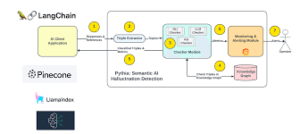
How Do AI Models Create False Information in Text Generation?
Biases in training data also contribute to the generation of false information. If the data sources used to train an AI contain inaccuracies, stereotypes, or biased perspectives, the model can inadvertently reflect and amplify these issues in its responses. For example, if a dataset overrepresents one viewpoint on a controversial topic, the AI may generate misleading or one-sided responses. This can create misinformation in politically sensitive discussions, scientific debates, or social issues.
A key issue in text generation is the tendency of AI to “fill in the blanks” when it lacks information. Instead of stating that it does not know the answer to a query, an AI model often attempts to construct a plausible-sounding response. This is particularly problematic in domains like medical or legal information, where inaccuracies can have serious consequences. If an AI-generated medical response provides incorrect dosage recommendations or misinterprets symptoms, it could mislead users into making harmful decisions.
Misinterpretation of ambiguous queries also leads to false information. AI models do not possess true comprehension of language; they rely on learned patterns to determine meaning. When faced with ambiguous or complex prompts, the model may generate incorrect conclusions. For instance, if asked about a hypothetical event that has not occurred, the AI might fabricate details rather than recognizing that the event is fictional. This tendency can spread misinformation when AI-generated content is taken at face value.
To reduce false information in text generation, AI developers use methods like reinforcement learning from human feedback, adversarial testing, and retrieval-augmented generation, where models pull verified data from trusted sources instead of relying solely on pre-trained knowledge. While AI models have improved in their ability to generate accurate text, mitigating false information remains a critical challenge. Continuous advancements in training techniques, transparency, and user awareness are essential for ensuring AI-generated content remains factual and trustworthy.