
 admin
admindifferent types of rigid flex board materials
Rigid flex circuit boards are used in applications that require high reliability, durability and flexibility. They are often seen in medical imaging equipment, military missile guidance systems, cameras and video cameras, wearable electronics, vehicle infotainment systems and industrial robotics. Rigid flex boards are comprised of rigid and flexible PCB layers that are glued together with various adhesives. The rigid portion provides strength and mounting points while the flex portion allows for movement in three-dimensional spaces. This combination of rigid and flexible circuitry creates a highly efficient product with increased device populations and reduced overall board size.
Choosing the right rigid flex board materials is critical to ensure the board can perform in harsh environments and meet the design’s specified minimum allowed bending radius. A rigid-flex circuit board’s material selection, thickness, copper weight, conductor metallurgy and dielectric properties need to be carefully chosen to meet the required flexibility, conductivity, stability and thermal cycling requirements of the application.
Fabrication process factors like temperature, humidity, chemical exposure, shock and vibration must also be factored in when selecting the PCB material. This is particularly important for applications that will experience frequent flexing, such as automotive products.
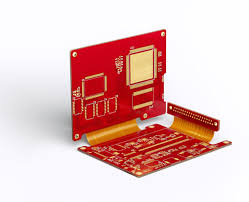
Are there different types of rigid flex board materials?
The conductor layer of a rigid-flex PCB is typically etched from copper foil. This foil can be electro-deposited (ED) or rolled, and it may need to be surface treated. Generally, it is coated with a thin layer of zinc to enhance longevity, improve adhesion, augment bond strength, reduce oxidation and prevent corrosion. Often, the copper is also plated with gold to enhance corrosion resistance and electrical performance.
For rigid-flex circuits, the layers are assembled using a variety of different types of adhesives and lamination techniques. Polyester adhesives are cheap, but they have low bond strength and cannot withstand elevated temperatures. More sophisticated adhesive materials include polyimide and epoxy resins. Polyimide adhesives are able to withstand extreme temperature fluctuations and provide superior abrasion resistance.
Coverlay and bondpiles are additional rigid-flex PCB material options that can be added to the flex-substack. Coverlay insulates the flex circuitry on surfaces, and it protects from corrosion and damage by preventing the copper from lifting. A typical coverlay construction consists of an outer PI or PET film and a flexible solder mask ink. Bondpiles are similar to coverlay constructions, but they’re usually used on inner stripline layers.
Conductors and vias are routed through the conductive layer, and they connect to the flex circuitry. Vias can be plated with gold, silver, nickel or lead to increase corrosion resistance, reduce impedance and increase conductivity. Using different via types is another way to optimize a rigid-flex PCB for flexibility.
The remaining parts of a rigid-flex circuit board are the insulator and substrate layers. These can be made from various rigid and flexible polymer materials including polyimide, Kapton, FR4, PTFE, or a composite of these. The insulation layer must be bonded to the flex substack with a no-flow or low-flow prepreg. Low-flow prepregs have fiberglass weaves within them to reinforce the flex-to-rigid joins.